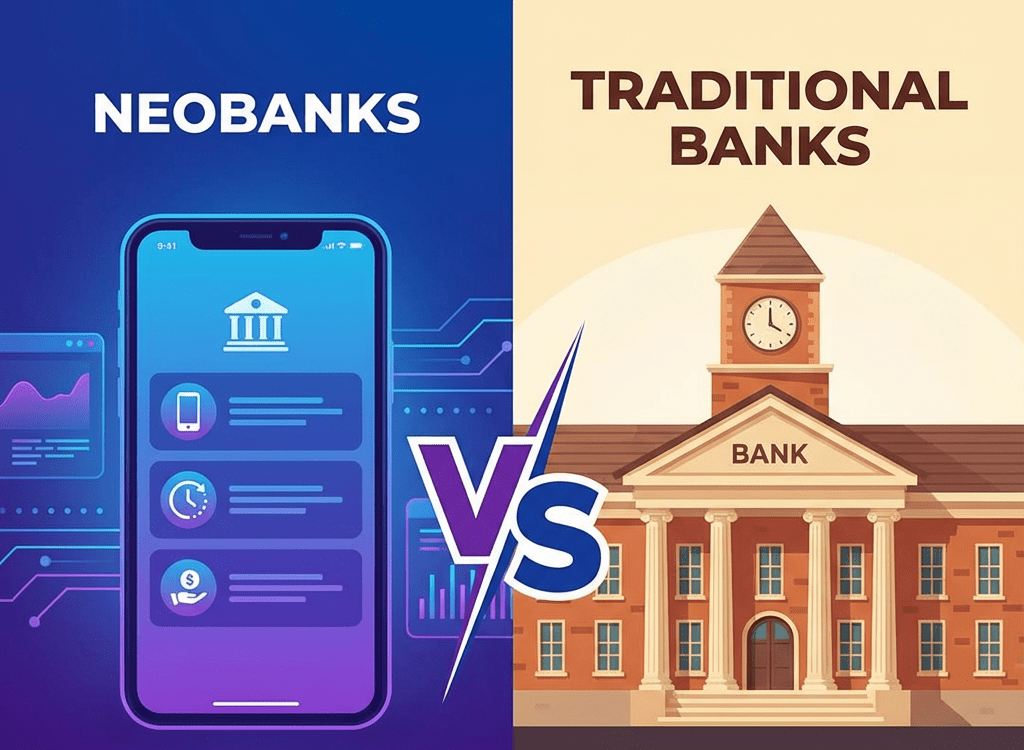
The way you bank in 2026 is a fundamental choice: the digital-first convenience of a neobank or the full-service familiarity of a traditional bank. It’s no longer a question of which is “better,” but which ecosystem aligns with your financial lifestyle, priorities, and how you physically interact with your money. This guide cuts through the branding to help you decide.
Defining the Players: Two Different Philosophies
A Traditional Bank is what most people picture: an institution with a national or regional network of physical branches (like Chase, Bank of America, or a local credit union). They offer a full suite of financial products—checking, savings, loans, mortgages, investment services—often under one roof. Their model is built on long-standing customer relationships, in-person service, and comprehensive offerings.
A Neobank (or digital bank) is a bank without physical branches. They operate exclusively through a mobile app and website. While some are independent fintech companies (like Chime, Revolut, or N26), many are actually the digital banking divisions of established financial institutions, leveraging modern tech to offer a distinct user experience. Their model is built on low overhead, sleek design, and solving specific consumer pain points with technology.
The Neobank Advantage: Where Digital Wins
Neobanks compete by excelling in areas where traditional banks are often slow, expensive, or clunky. Their most compelling benefit is cost structure. With no branches to maintain, they eliminate most common fees. You’ll typically find no monthly maintenance fees, no minimum balance requirements, and often no overdraft fees or foreign transaction fees. This can save the average user hundreds of dollars per year.
They also lead in user experience and speed. Account opening takes minutes, not days. Their apps are intuitively designed for daily money management, with real-time transaction notifications, powerful spending analytics, and instant peer-to-peer payments. Features like early direct deposit (getting your paycheck up to two days early) and automated savings “round-up” tools are standard. For the digitally-native user, it’s a seamless, integrated financial dashboard.
The Traditional Bank Strength: Services and Security
Traditional banks counter with depth, breadth, and a human touch. Their greatest strength is comprehensive service. If you need a mortgage, a small business loan, a safe deposit box, or sophisticated wealth management, a traditional bank or credit union is a one-stop shop. Complex financial needs often require in-person consultation and established relationships with bankers.
They also provide tangible access and cash handling. The ability to walk into a branch to resolve a complex issue, deposit a large check or cash, or get a bank check instantly is irreplaceable for many. For small business owners or individuals who deal frequently with cash, this infrastructure is critical. Furthermore, the sheer size and history of major banks provide a perceived (and often real) sense of stability and established security protocols that some customers still prefer.
The Critical Comparison: Where Each Falls Short
The choice becomes clearer when you examine the trade-offs. The primary limitation of neobanks is their narrow scope. They are fantastic for day-to-day checking and savings but are rarely a full-service financial partner. Need a notary? A cashier’s check today? A financial advisor? You’ll likely be out of luck. Customer service, while often efficient via chat, can be frustrating for problems that require nuanced human intervention.
Conversely, the traditional bank weakness is cost and inertia. Monthly fees, high overdraft charges, and lower savings interest rates are the price of their physical network. Their digital apps, while improved, often lag behind neobanks in design and innovation. The experience can feel bureaucratic compared to the sleek, customer-centric approach of a digital challenger.
Making the Choice: A Framework for Your Lifestyle
Your ideal bank isn’t about technology for its own sake; it’s about which model serves your real-world habits. You are likely a better fit for a Neobank if: your financial life is almost entirely digital; you value avoiding fees above all; you rarely need to deposit cash or visit a branch; and your needs are simple (checking, savings, debit card). They are ideal for renters, younger professionals, frequent travelers, and fee-averse consumers.
You are likely a better fit for a Traditional Bank or Credit Union if: you anticipate needing complex loans or financial advice soon; you operate a cash-heavy small business; you frequently deal with checks or large transactions requiring a branch; or you simply value the option of face-to-face service for peace of mind. They are ideal for homeowners, business owners, those nearing retirement, and anyone who prefers a known, established institution.
The Winning Strategy for 2026: The Hybrid Approach
For a growing number of people, the optimal solution in 2026 is not an either/or choice, but a strategic hybrid approach. This leverages the strengths of both worlds.
A common and powerful setup is to use a neobank as your primary transactional hub. Open a fee-free checking account with a high-yield savings account attached for your daily spending, emergency fund, and bill payments. Enjoy the great app, no fees, and higher savings yields.
Simultaneously, maintain a minimal account at a traditional bank or credit union. Use it as a “service branch” for those rare times you need in-person services: depositing cash, getting a cashier’s check for a home down payment, or securing a mortgage. You can avoid its fees by meeting a low minimum balance requirement or using it only for specific transfers.
This way, you optimize for cost and convenience 99% of the time, while retaining access to full-service infrastructure for the 1% of occasions you truly need it.
Your Action Plan: Audit, Align, and Open
- Audit Your Habits: Track how you banked over the last 90 days. How often did you visit a branch? Deposit cash? Need a service you couldn’t get online?
- Align with Your Goals: What are your major financial goals in the next 3-5 years (buying a home, starting a business)? Which institution is equipped to help?
- Research & Open: If you choose a hybrid model, start by opening the neobank account for its immediate benefits. Then, find a local credit union or national bank with a convenient branch for your legacy account.
The future of banking is choice. By understanding the core model of each player, you can move your money from a place that charges you for old infrastructure to a system that actively works for your modern financial life.
Disclaimer: This article is for educational purposes only and is not financial advice.
 The FinanciaLogic
Leave a comment